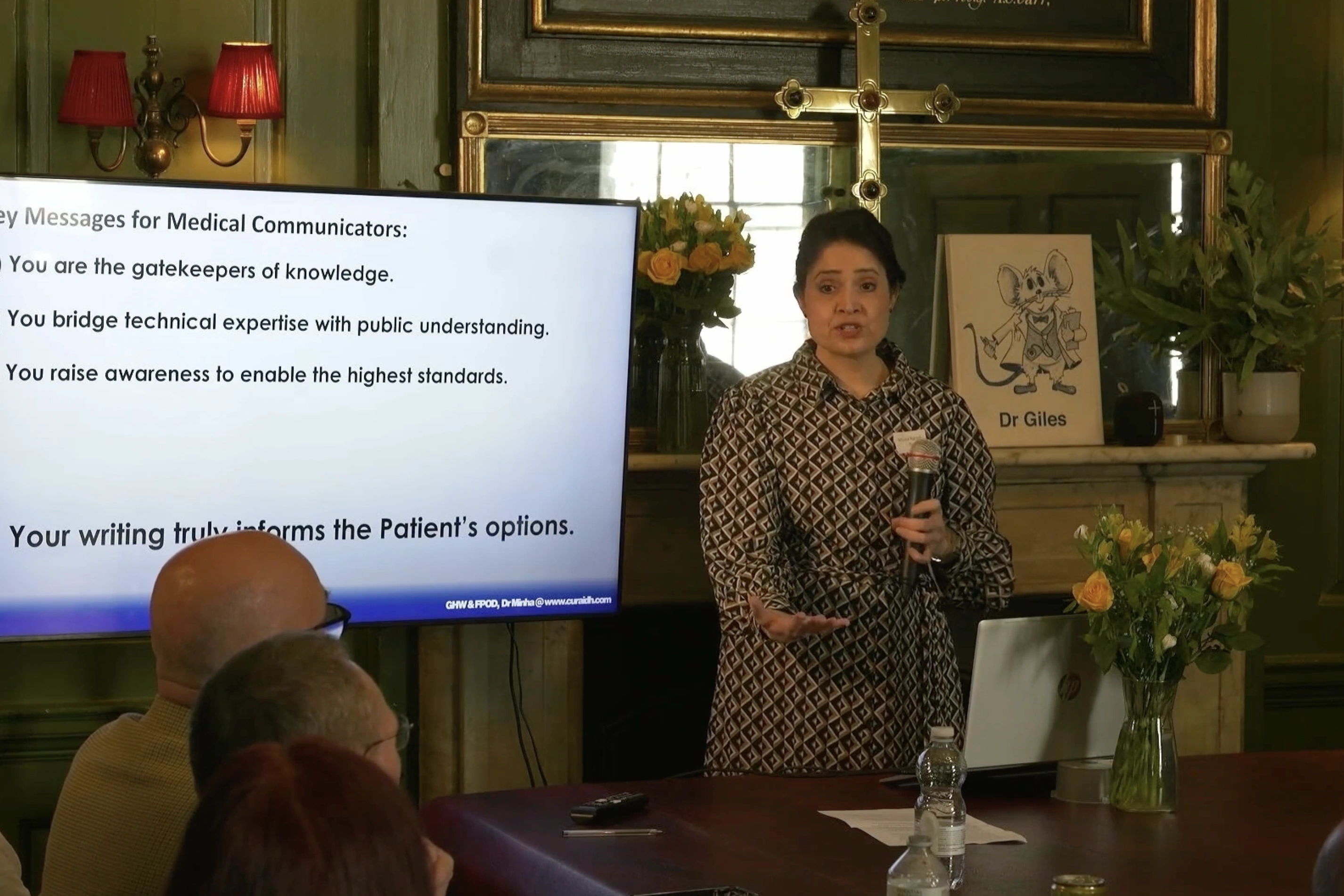
Dr Minha presented “Navigating the Patient–Physician Dynamic Through the Lens of Antiphospholipid Syndrome” alongside expert patient Tracy Jallow BEM at “Enduring Symptoms: From Patient Voices to Solution-Driven Care”, the Forgotten Patients, Overlooked Diseases (FPOD) conference held at the Royal College of Physicians in London on 24 June 2026.
Antiphospholipid syndrome (APS) is an autoimmune condition in which the immune system mistakenly attacks proteins in the blood, raising the risk of clots, stroke and recurrent miscarriage. Like so many of the conditions FPOD champions, it can go unrecognised for years while patients cycle through appointments without answers.
Tracy knows that delay first-hand. She lived with APS for seventeen years before her diagnosis: years in which serious clotting-related complications built up while test after test came back inconclusive. As she told the room, the hardest part wasn’t being disbelieved by a doctor; it was beginning to disbelieve herself. Honoured with the British Empire Medal for her work as an expert patient, she has turned that experience into education for the next generation of clinicians.
Rather than a conventional lecture, the pair built the session around a framework Dr Minha adapted from her work in occupational medicine. It moves through the demands a hidden illness places on a person, the question of where they belong in a siloed health system, the timeline of missed opportunities, the team around them, and finally ownership and leadership of their own care. At each step Tracy gave the patient’s account and Dr Minha the clinician’s, side by side, as equals.
Some of the most telling moments were the smallest. Dr Minha described the ten seconds she takes at the start of every appointment, telling the patient that no one before them or after them is in her mind, only they are. It is a pause she finds nine in ten patients welcome. She spoke of the clinician as a “familiar stranger”, entrusted with a patient’s story, and of how disease can present outside the published literature: livedo reticularis (a mottled, lace-like discolouration of the skin) can look markedly different on Indian skin than on Caucasian skin, a distinction she had to reach for the Indian Journal of Dermatology to find properly documented. She also had practical advice, including her encouragement to patients to make a subject access request for their own records, so a scattered history can finally be read on a single page.
The setting completed the picture. The Royal College of Physicians, one of medicine’s most storied institutions, was hosting a charity built for the patients medicine overlooks. Dr Minha, who serves FPOD pro bono as a medical advisor, presented at the charity’s fifth collaboration with her: a partnership that mirrors Curaidh Clinic’s own purpose, taking enduring, unexplained symptoms seriously and pairing clinical rigour with genuine partnership between doctor and patient.
Their closing line, delivered together, captured the whole session: the dots join when patient and physician co-create.
Hosted by Forgotten Patients, Overlooked Diseases. Read the full story of the day in Expert Insights.