Learning from a Legend: Dr Kazutaka Kogi and the Science of Ergonomics
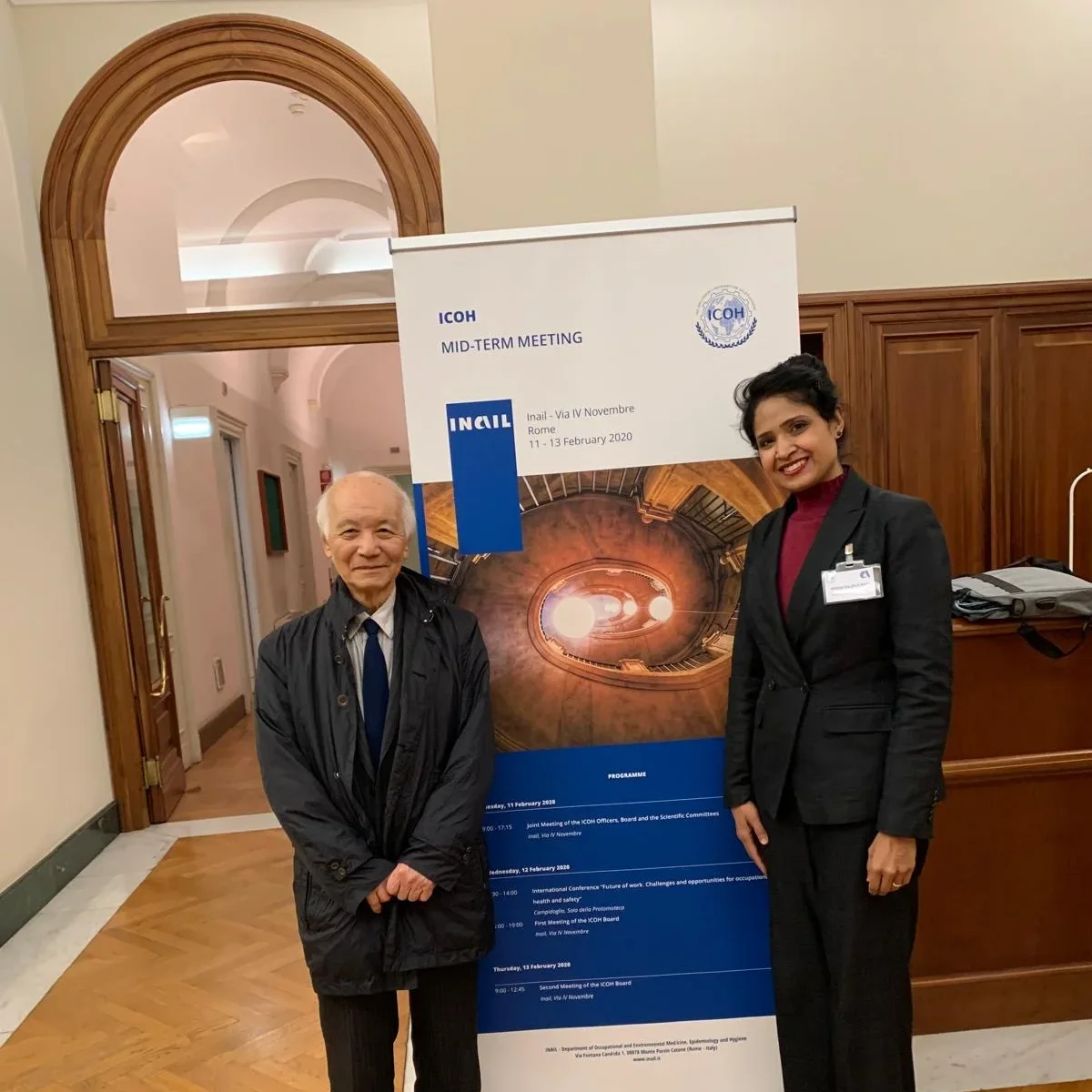
Dr Minha with Dr Kazutaka Kogi, former ICOH President and father of participatory ergonomics, a mentor who helped shape her occupational medicine career.
Some photographs are really about a debt of gratitude. This one was taken at the International Commission on Occupational Health’s Mid-Term Meeting in February 2020, hosted in the historic headquarters of INAIL, Italy’s national institute for insurance against accidents at work, where ICOH’s officers, board and scientific committee chairs gathered from around the world in the final weeks before the pandemic changed everything. Standing with Dr Minha is the legendary Dr Kazutaka Kogi, President of the Commission from 2009 to 2015, by then its Past President, and one of the founding figures of modern occupational health.
Dr Kogi is widely regarded as the father of participatory ergonomics, the deceptively simple idea, which he helped introduce in 1983, that the people who do a job and the people who manage it should design workplace improvements together, rather than having change imposed from above. Through the International Labour Organization he developed practical, low-cost training programmes that spread across the developing world and beyond, and much of what we now take for granted in workplace health and safety traces back to that work. In 2022, ICOH honoured him with its Lifetime Achievement Award.
For Dr Minha he was far more than a distinguished colleague. A mentor and teacher who, in her words, “took me as a daughter,” he guided and inspired her throughout her leadership of large workforces in occupational and disability medicine, part of the ecosystem of teachers she credits with shaping the doctor she became.
His influence is visible in every Curaidh Clinic consultation. When Dr Minha assesses a patient she is not only looking at their biochemistry but at their posture, their workstation, the repetitive demands of their working day, the whole person in the whole context of their life. It is, as she puts it, a little like seeing six different specialists in a single appointment: the essence of integrative medicine, with Dr Kogi’s fingerprints on it.