
Rethinking Chronic Pain at the 56th British Pain Society Meeting
At the British Pain Society’s 56th Meeting in Glasgow, Dr Minha explored the latest thinking on chronic pain and reducing long-term opioid reliance.
In May 2023, Dr Minha travelled to Glasgow for the British Pain Society’s 56th Annual Scientific Meeting, attending, as it happened, just weeks after her own discharge from hospital and at a turning point in her recovery. “A makeup and a nice dress for ladies,” she says of that day, “makes all the difference.” The British Pain Society is the UK’s leading multidisciplinary professional body for pain: founded in 1967, it now brings together more than 700 doctors, scientists, nurses, physiotherapists, psychologists and people with lived experience of pain, and since 1989 it has been the British chapter of the International Association for the Study of Pain.
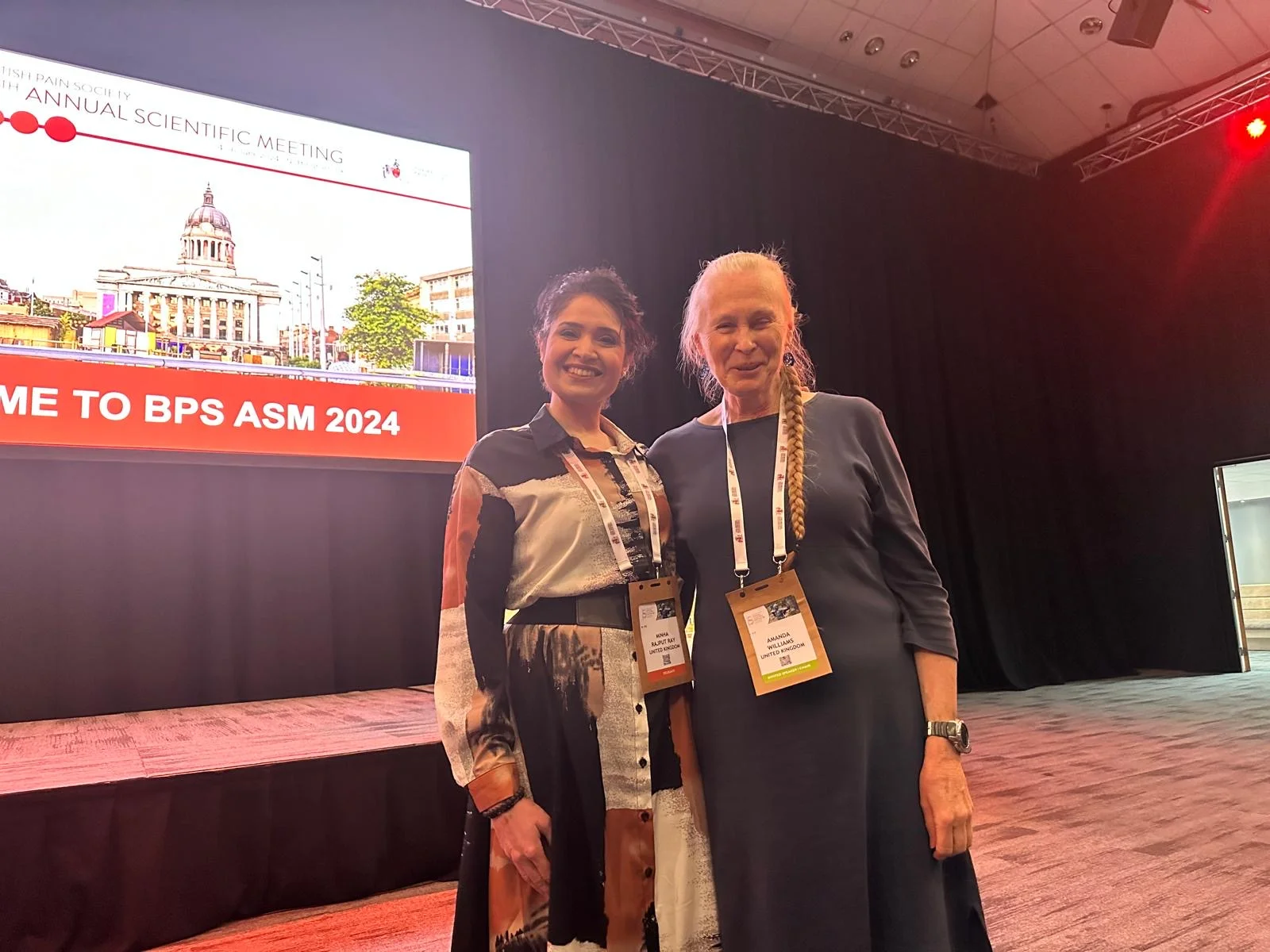
Held from 9 to 11 May, the Annual Scientific Meeting is the Society’s flagship event, three days in which the UK pain community shares the latest research and debates the challenging, sometimes controversial questions facing clinical practice and health policy. The 2023 programme ranged widely across the science and delivery of pain care, with a strong thread running through it on one of the field’s most pressing challenges: how to help patients safely reduce their reliance on long-term opioids, and what should take their place when standard painkillers begin to do more harm than good. The programme board beside her in the photograph catches that breadth, sessions ranging from primary-care management of musculoskeletal pain to spinal cord stimulation and, fittingly for an occupational physician, pain at work.
It was against that backdrop that Dr Minha had what she describes as her first serious introduction to legal medical cannabis, understanding its safety profile, its limits, and the specific circumstances in which it might be considered once routine pain medication is no longer suitable. It remains a widely misunderstood subject. Medical cannabis has only been legal to prescribe in the UK since 1 November 2018, and only by specialist doctors on the General Medical Council’s specialist register, never by GPs alone. The NHS prescribes it in tightly defined circumstances, chiefly rare and severe forms of childhood epilepsy, muscle spasticity in multiple sclerosis, and chemotherapy-related nausea, and is candid that the evidence for cannabis in chronic pain is not yet strong enough to recommend it routinely.
For Dr Minha, that was the real value of the meeting: not every conference requires a speaking slot, and attending simply to learn is often what brings new thinking straight back to patients. It is a subject she has continued to follow closely since, engaging with some of the field’s pioneers and seeing at first hand the rigour with which regulated medical cannabis is produced in this country.
The wider lesson she carried home from Glasgow, weighing every option carefully, on the evidence, for the individual in front of you, is exactly how Curaidh Clinic approaches chronic pain: conventional medicine first, an integrative toolkit alongside it, and a constant, critical eye on what the research genuinely supports.